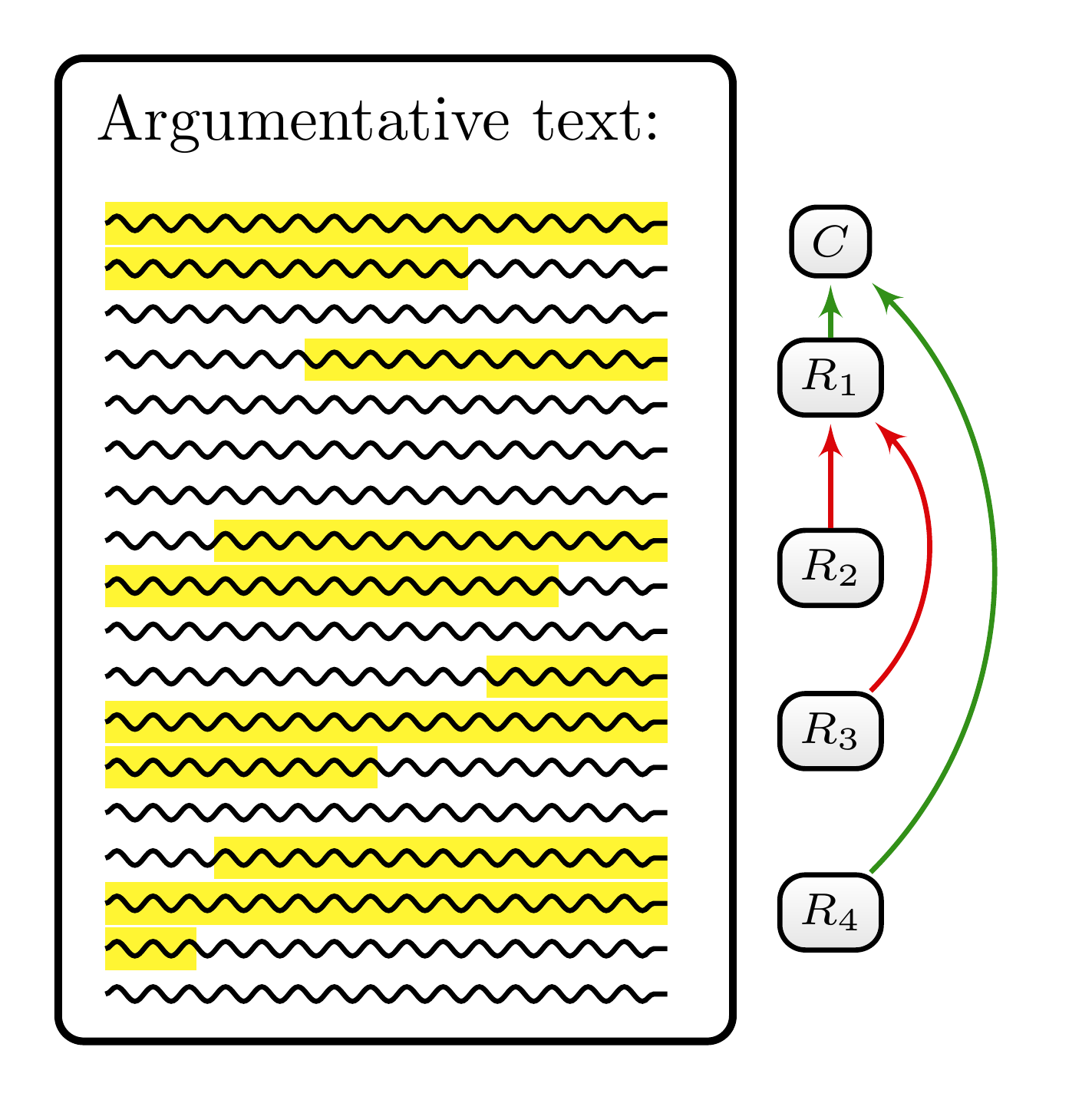
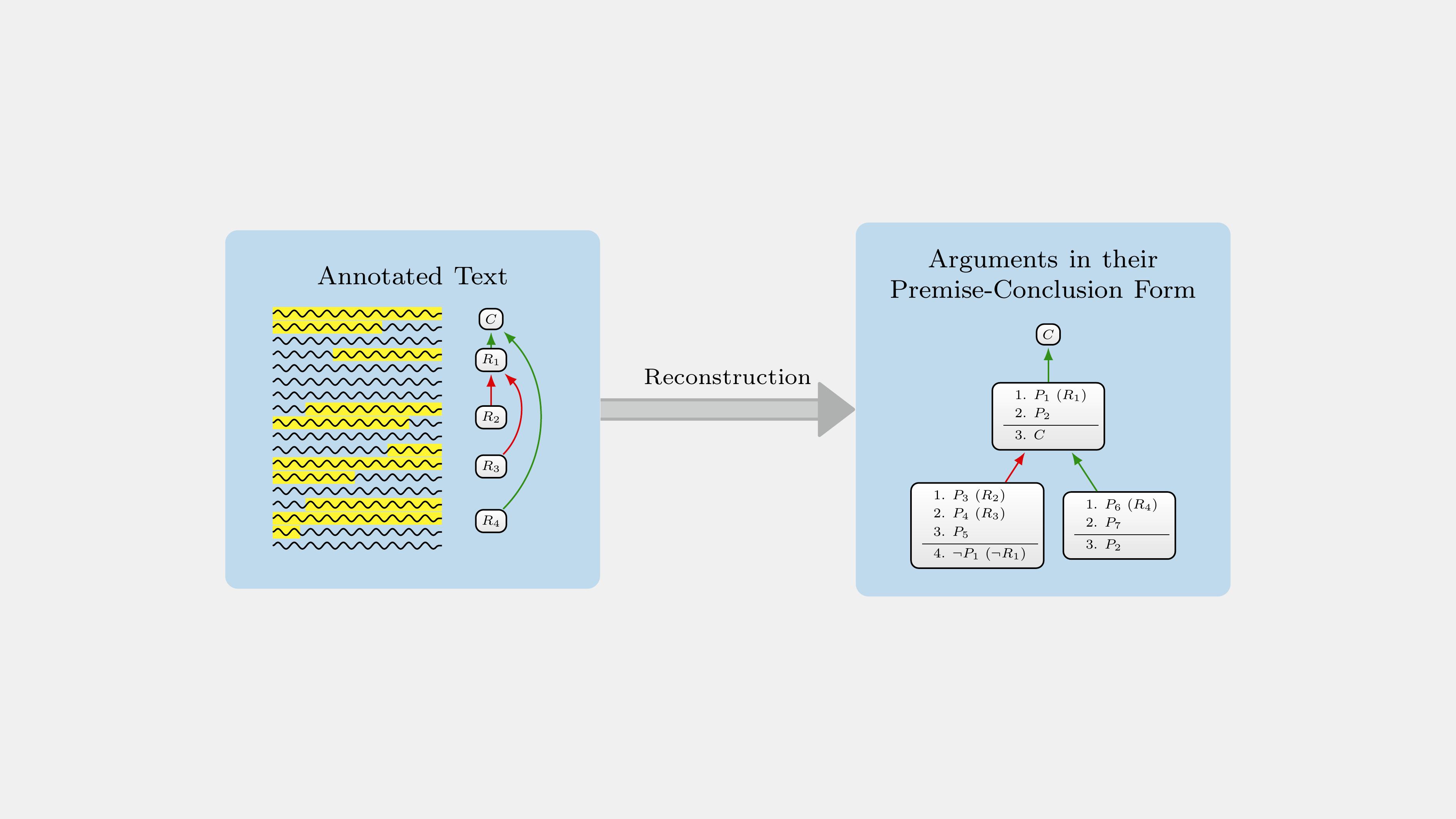
Argumentative Content Analysis is a research method to analyse argumentation by identifying argumentative components and their relations in texts. It advances methods from argumentation theory to be used in social-empirical research by borrowing and adapting methods from content analysis and can be applied to various types of discourse, including political speeches, parliamentary debate, media articles, academic papers, and online discussions.
Argumentative Content Analysis involves the following steps:
-
Surface-level annotation of argumentative components: The first step in argumentative content analysis is to identify the argumentative components and their relations in a given text. The analyst has to identify those textspans that are argumentatively relevant and has to discern their argumentative function. Depending on the argumentation-theoretic background, an argumentative component can be a claim, a reason, an argument, a counterargument, a refutation, a premise, or a conclusion. Usually, these argumentative functions are relational. For instance, a textspan representing a reason is typically a reason for another textspan that represents might represent a claim; a textspan representing a counterargument is typically a counterargument against another textspan that represents an argument. Accordingly, the resulting annotations are relational and can be represented as a directed graph, where the nodes represent the argumentative components and the edges represent the argumentative relations between them.
-
Deep-level analysis of arguments: The second step in argumentative content analysis is to analyze the identified argumentative components and their relations in by applying method from argumentation theory to gain a deeper understanding of the argumentation. For instance, by applied formal logic and informal logic can be used to reconstruct arguments in their premise-conclusion form to identify implicit premises and conclusions, to evaluate the validity and soundness of arguments, or to identify fallacies.
Methodological Challenges
Argumentative Content Analysis is yet to be fully developed as a research method. There are several methodological challenges that need to be addressed, including:
-
Which scientific criteria from argumentation theory are relevant? How should they be altered to be applicable in social-empirical research? Argumentation theory is usually taught at universities to provide students with methods to understand and evaluate arguments in texts systematically. Depending on the analytical aims, different hermeneutical criteria (for instance, exegetical accuracy and charity) are relevant and must be weighed against each other. This context of personal knowledge acquisition and understanding differs in many ways from social-empirical research. Accordingly, it stands to reason that the desiderata of argumentation theory must be adapted to argumentative content analysis.
-
Which scientific criteria from content analysis are relevant? How should they be altered to be applicable in social-empirical research? Analysing argumentation in a specific context comes with challenges. This might require adapting scientific criteria from content analysis (e.g., reliability and validity). For instance, reliability—usually operationalised as agreement among coders annotating the same text—is a central concern in content analysis. However, analysing argumentation is a hermeneutical task requiring interpretation. Often, there is no single correct interpretation, but rather a set of plausible ones. Accordingly, reliability is difficult to achieve due to interpretive subjectivity. What does this imply for the scientific criteria of argumentative content analysis? Should reliability be dropped as a criterion, or can a weakened version be formulated that remains faithful to its guiding idea?
Posts involving argumentative content analysis
See all →
Back to top