1 Visualising Argumentation Structures with Reason Maps
1.1 Argumentative Texts
What are argumentative texts and their argumentation structures? A text is argumentative if it contains, among other things, reasons and arguments in favour of one or more claims. It can also contain objections to these arguments and claims, along with refutations of those objections. The term argumentative component will be used as an umbrella term for these different elements. Text segments that formulate argumentative components will be referred to as argumentative units. In other words, an argumentative unit is a text segment that expresses an argumentative component. This distinction is important since different argumentative units can express the same argumentative component. For instance, a claim can be expressed by different text segments in a text.
Essays are typically argumentative. But argumentation can also be found in other texts, such as newspaper articles, scientific articles, transcribed interviews, forum entries, text messages, tweets, blog posts and books.
Argumentative components are usually related to each other by argumentative relations. For instance, an objection is usually directed at a specific argument or claim, and a refutation is usually directed at a specific objection. The argumentation structure of an argumentative text refers to the set of the text’s expressed argumentative components together with the different argumentative relations between them.
Let us have a look at the following hypothetical dialogue:
Clint: I think we should all follow a vegetarian lifestyle.
Audrey: Why?
Clint: Because most mass meat-farming techniques are torture to animals.
Audrey: Is that so?
Clint: Yes! There is good evidence that animals feel fear and pain like us. Mass meat-farming techniques force animals living in them to have an unnaturally short, miserable and confined life.
Clint begins by formulating a claim about vegetarianism, and Audrey challenges this claim by asking for a justification. Clint answers this request by providing a reason or, in other words, an argument in favour of that claim. For this guideline, we shall not distinguish between reasons and arguments. We will treat the two concepts as more or less interchangeable.1 What is important, though, and exemplified in the dialogue above, is that arguments and reasons are always relational. A reason is always a reason for another statement; similarly, an argument is always an argument in favour of another statement. Therefore, a complete description of an argument (and a reason) should be formulated in the following standard form:
x is a reason/argument for y.
Identifying an argument (or a reason) demands identifying both relata ‘x’ and ‘y’. In the above example, we can consider Clint’s answer to Audrey’s first question as a reason (x) for his initial claim (y).
Audrey reacts to Clint’s answer by demanding another justification, and Clint willingly provides a further reason. But for which claim is Clint’s last answer a reason? Without the cotext of Clint’s second answer—that is, all that was said besides this answer—we can easily imagine the answer as another reason for vegetarianism. However, the way the dialogue proceeded, another interpretation is more appropriate: Audrey’s second question refers to Clint’s first answer. She asks whether mass meat farming is torture for animals. Clint answers in the affirmative and justifies why mass meat farming should be considered torture. In this particular dialogue context, the second answer should, therefore, be considered a reason for the first answer.
1.2 Reason Maps
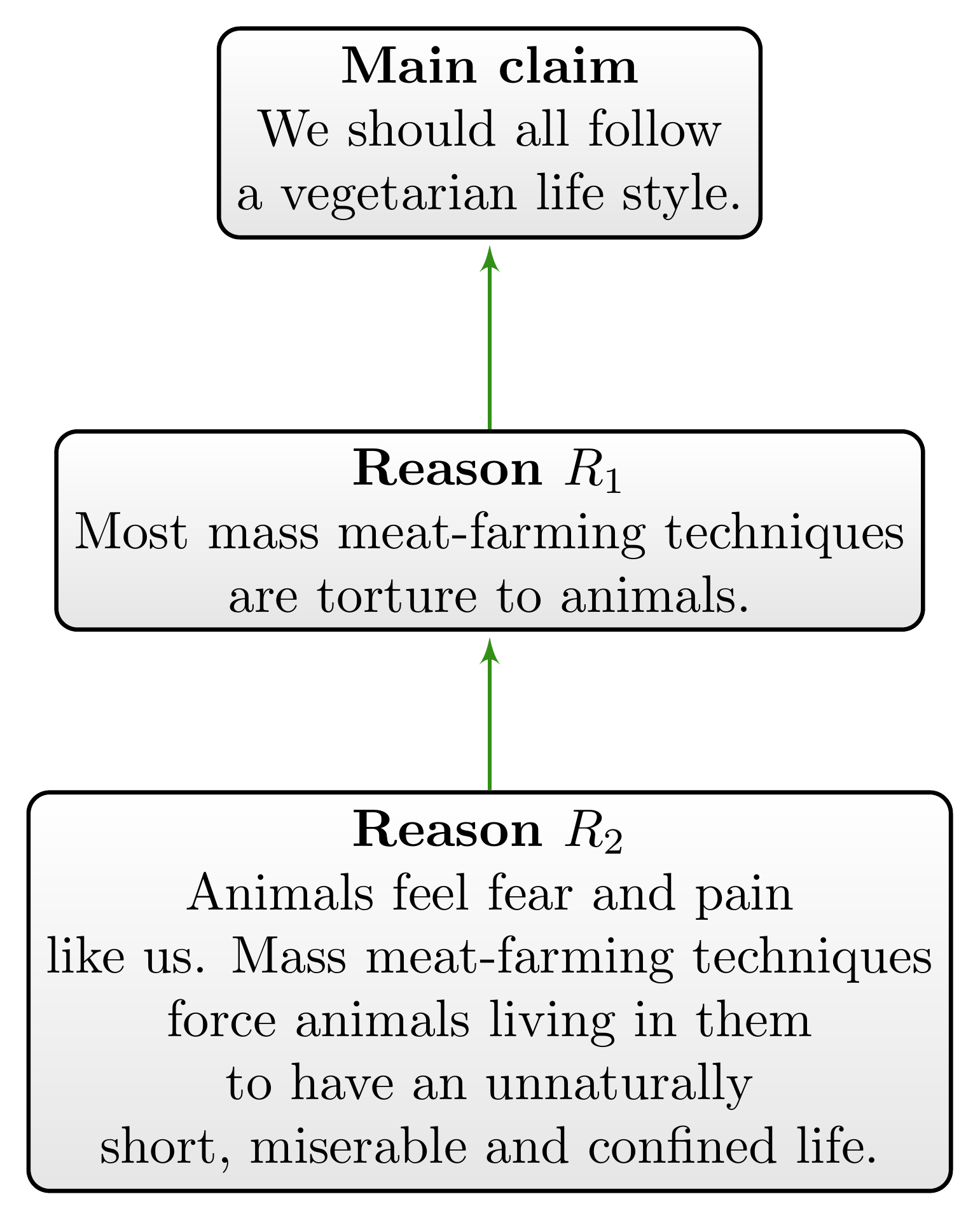
We can thus describe the structure of the argumentation as follows: The argumentation contains a claim for which a reason is presented, and this reason is itself backed up by an additional reason. Figure 1.1 is a reason map, which visualises the main claim, reasons and their relationships to each other. As we will see, reason maps can get more complex.
The nodes of a reason map represent text segments of the dialogue that express argumentative components, and the argumentative relations between them are visualised by arrows. Green arrows represent so called support relations. If a text segment x is presented as a reason or argument for another text segment y, then there is green arrow from x to y.
So far, the dialogue’s argumentation structure is simple. Let us look at the following more complex continuation of the dialogue:
Audrey: But even if that were true, there are alternative ways to breed animals. Grass-fed meat comes from animals raised in open grass pastures and not confined to these cramped living spaces.
Clint: Yes, but there are other reasons to be a vegetarian. Animal farming produces more greenhouse gas emissions than the world’s entire transport system, and these greenhouse gases are causing a dangerous climate change.
Audrey begins by raising an objection. Similar to reasons, objections are relational: An objection is always an objection to another argumentative component and should be described in some standard form (e.g., ‘x is an objection to y’), which makes the relata of that relation explicit. Often, an objection to y is a reason that y is false or implausible.
So, what is the nature and target of Audrey’s objection? She does not question that animals feel fear and pain when they grow up in meat farms. As a consequence, the target of her objection is not the second reason (\(R_2\)). But she formulates a reason that animal suffering is not a sufficient reason for becoming a vegetarian since there are alternatives to mass-produced meat that avoid the suffering of animals, or so her reasoning goes. Hence, the target of Audrey’s objection is Clint’s first reason (\(R_1\)) because her objection questions the relevance or sufficiency of \(R_1\).
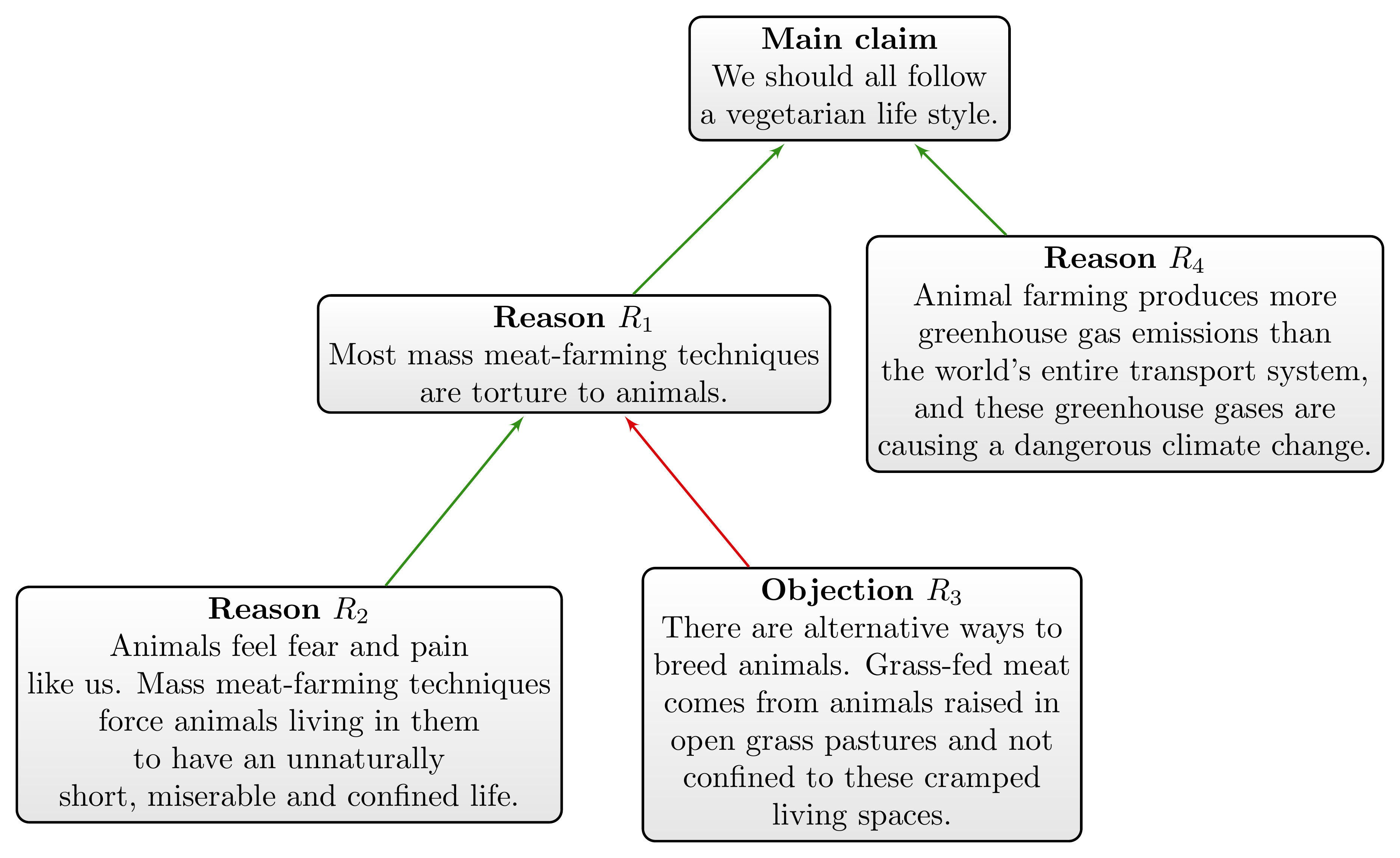
Objections will be visualised in a reason map by an attack relation represented by a red arrow, as illustrated in Figure 1.2.
Clint’s point about greenhouse gas emissions illustrates that reason maps can be more branched than the simple serial reasoning we began with (see Figure 1.1). His reply to Audrey does not refute her objection (\(R_3\)). On the contrary, he seems to concede her point. Hence, Clint’s point is not an objection to Audrey’s reasons. Instead, he presents an alternative reason to the main claim as visualised in Figure 1.2.
In argumentation theory, an argument is usually considered a complex entity with an internal premise-conclusion structure. The conclusion is what is supposed to be justified with the argument, and the premises are the sentences that formulate the justification. According to this understanding, reasons are premises as parts of arguments.↩︎