6 Identifying the Target of Support and Attack Relations
In the last example (Example 5.1), we used Tip 5.6 to identify a chain of supporting reasons that we did not initially spot. We saw how Tip 5.6 can help to discern support relations between argumentative components, even if there are no obvious linguistic cues for these relations. Reformulating the basic idea of argumentative components in your own words can also help with other problems of analysing the argumentation structure in a text.
For instance, you might identify an argumentative unit that is formulated as a justification without being able to say what it justifies. The linguistic cues might univocally signpost the text segment as a reason but fail to clarify the exact target. Such a situation leaves the annotator to decide among different possibilities regarding what is supposed to be justified. Tip 5.6 might help to decide between these different possibilities. You should formulate the potential relations in some of the suggested standard forms and choose among them by applying the principle of charity and accuracy. The main idea is to choose among these possibilities by comparing the different formulations based on their plausibility and how well they capture the author’s intended reasoning.
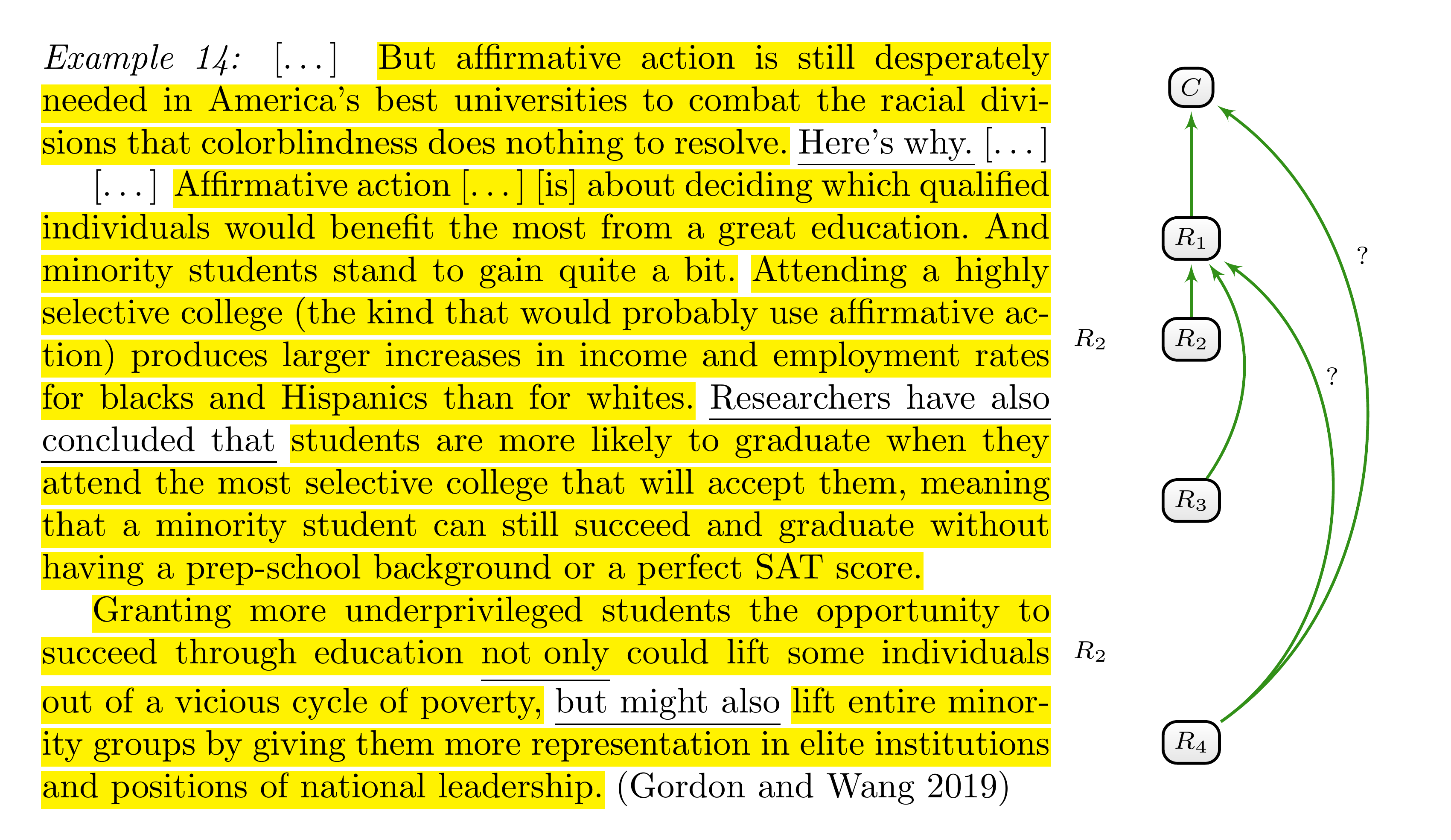
The example in Figure 6.1 extends the example from Figure 5.5 and provides a concrete illustration of the problem. The main claim in favour of affirmative action is supported by a single reason (\(R_1\)), which argues that it will benefit qualified students from minority groups. The text moves on to provide a supporting reason for this claim, pointing to an increase in income and employment (\(R_2\)) and to the fact that qualified students are more likely to graduate from elite universities (\(R_3\)). The last paragraph begins by reformulating \(R_1\) and goes on to add another point. The phrase ‘not only …, but also…’ designates this last point as a supporting reason. But it is less clear what exactly is being justified. Since the preceding reasons \(R_2\) and \(R_3\) support \(R_1\), one might speculate whether \(R_4\) is another reason in support of \(R_1\). However, since the phrase refers to \(R_1\) in the first clause, which supports the main claim \(C\), it is similarly possible that \(R_4\) is another reason for the main claim.
According to Tip 5.6, we should first formulate both possibilities in a way that makes the reason and its target explicit (explicitness), which might demand reformulating some text segments.
Support from \(R_4\) to \(R_1\): Affirmative action should help those qualified individuals who would benefit the most from an excellent education. Minority students stand to gain quite a bit since it might lift entire minority groups by giving them more representation in elite institutions and positions of national leadership.
Support from \(R_4\) to \(C\): But affirmative action is still desperately needed in America’s best universities since it might lift entire minority groups by giving them more representation in elite institutions and positions of national leadership.
We now have to compare these different possibilities in terms of how strong or plausible the resulting support is (charity) and which formulations adhere best to the author’s known or hypothesised intention (accuracy). From the viewpoint of plausibility, both possibilities seem to be fine: Since whole minority groups benefit from a better representation (first possibility), students that belong to these groups will benefit as well (second possibility). However, accuracy favours the second interpretation. The author’s intended point is to justify affirmative action not only by the benefits it provides to individuals from minority groups who attend elite universities as a result of affirmative action, but also by how it will benefit other individuals from these minority groups. This point is only captured in the second formulation.
While Tip 5.6 will often help you identify the target of support and attack relations, some cases remain ambiguous. Different possible interpretations might be similarly charitable and accurate, or there might be a trade-off between charity and accuracy. In these cases, you can freely pick one of your interpretations.
However, keep in mind that the author might intend to justify two different things with the same text segment. In such a case, you should annotate all the relations.
We will close this section with a general comment on the usefulness and scope of the provided tips. You might encounter cases where the tips will not disambiguate between all possible interpretations, and different annotators might come up with different interpretations when using the tips. However, while these tips will not always yield unique results, they are intended as rules of thumb that at least narrow down the degree of interpretation.